
|
Getting your Trinity Audio player ready... |
Types of Sprays Used in Fluid Bed Processors
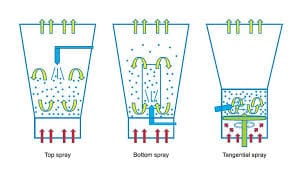
Types of Sprays: Fluid bed processors utilize various types of sprays, each designed for specific functions. The classification of these spray types is determined by their positioning within the system. Below are the primary types of sprays used in fluid bed processing:
- Top Spray
In a top spray system, the nozzle is positioned above key components such as the distributor, expansion chamber, or product container. This configuration is commonly used for processes such as wet granulation, drying, and coating. During operation, the machine disperses the coating liquid downward onto the bed of fluidized particles. This spray method is particularly effective for coating larger powders, pellets, and crystals, ensuring uniform application and improving the characteristics of the final product.
- Tangential Spray
Unlike the fixed position of the top spray nozzle, the tangential spray nozzle is adjustable, allowing it to be positioned at various heights. Typically, the nozzle is located on the side of the expansion chamber or product container. The tangential spray process functions through the spinning of a disk, generating centrifugal force. As air moves through adjustable gaps in the disk, it creates a lifting force, which causes particles to move upward. Gravity then pulls the particles downward, allowing them to fall back onto the disk. This combined motion ensures thorough and homogeneous mixing, coating, and drying of granules, resulting in uniform product consistency.
- Bottom Spray
In a bottom spray system, the nozzle is positioned at the base of the chamber, directing the spray upward. Particles move upward within the partitions before descending again. This continuous up-and-down motion facilitates even coating. The bottom spray technique is widely used in the pharmaceutical industry, particularly for drug layering and coating to control drug release rates. As hot air passes through the fluidized bed, it lifts the particles in a controlled stream of air. This method ensures a thorough and even application of coating materials, making it ideal for granulation and sustained drug delivery applications.
Key Components of a Fluid Bed Processor :Types of Sprays
A fluid bed processor consists of several essential components that work together to achieve optimal fluidization and processing efficiency. These include:
- Fluid Bed Nozzle: Regulates binder delivery in the form of droplets and ensures even distribution within the system.
- Air Distribution Plate: Facilitates the even distribution of fluidizing air between inner and outer partitions.
- Draft Tube or Plenum Chamber: Equalizes pressure while allowing air to enter, ensuring balanced air distribution.
- Cylinder (PG): Aids in the movement of particles by drawing them through partition gaps.
- Filter Bags: Prevents unwanted foreign particles from entering the system, enhancing fluidization efficiency.
- Expansion Chamber: Maintains particle movement and supports the consistent flow of material within the processor.
- Product Container: Serves as the primary chamber where powders or other materials are placed for processing.
- Control Panel: Houses controls for adjusting and monitoring operational parameters to achieve precise processing conditions.
- Exhaust Filter: Allows clean air to exit while trapping unwanted particulates.
- Solution Delivery System: Directs required processing solutions into the fluidization chamber.
- Exhaust Blower: Removes particulates and residues that may adhere to the system’s interior walls.
Optimizing Fluid Bed Processing Technology
Maximizing the efficiency and effectiveness of fluid bed processing technology requires adherence to several key principles:
- Regular Maintenance and Servicing: Ensuring that the machine is in peak working condition by conducting routine servicing and necessary repairs.
- Using Equipment for Its Intended Purpose: Selecting the appropriate fluid bed processor based on specific production requirements and application needs.
- Setting the Correct Processing Parameters: Fine-tuning the machine settings from the control panel to meet desired processing conditions, including air velocity, temperature, and spray rate.
- Accurate Timing and Monitoring: Properly timing each stage of the process to achieve consistent and optimal results.
Understanding Fluid Bed Drying Technology
Fluid bed drying technology is a widely used process for removing excess moisture from wet granules or particles. It relies on the fluidization principle, in which hot air flows through the spaces between particles, lifting and suspending them. When the air velocity counterbalances the gravitational force on the particles, the material enters a state of fluidization, appearing as if it is suspended in a boiling liquid. As the heated air comes into direct contact with the particles, it effectively removes excess moisture, leaving behind a dry product that meets specified moisture content requirements.
Comparing Fluid Bed Dryers and Drying Ovens
Fluid bed dryers and drying ovens are both used to reduce moisture content in materials, but they differ significantly in operation and application.
- Fluid Bed Dryers:
- Utilize hot air to suspend and fluidize particles, ensuring even drying.
- Used in various industries, including pharmaceuticals, chemicals, food processing, and metallurgy.
- Capable of additional functions, such as mixing powders to achieve homogeneous blends and agglomeration for granulation.
- Drying Ovens:
- Use static heating to remove moisture from materials without fluidization.
- Commonly used for sterilizing lab equipment, dehydrating food products, and preserving materials.
- Lack the forced air circulation and suspension characteristics of fluid bed dryers, making them less efficient for uniform drying of granular substances.
How Fluid Bed Dryers Work
The working principle of a fluid bed dryer is based on fluidization. Below is a step-by-step outline of the process:
- Loading: The material to be dried is placed in the product container.
- Initiation: The machine is powered on, and processing parameters are set via the control panel.
- Fluidization: A stream of hot air is introduced from below the drying bed, passing through the spaces between particles and lifting them.
- Suspension: As air velocity increases, the upward force exerted on the particles matches the gravitational pull, causing the material to suspend in a fluidized state.
- Moisture Removal: The direct contact between the particles and heated air eliminates moisture.
- Completion: Once the particles reach the desired moisture content, the airflow stops, and the dried material settles back into the container, ready for further processing.
Difference Between Fluid Bed Granulators and Fluid Bed Dryers
While both fluid bed granulators and fluid bed dryers utilize fluidization, they serve distinct purposes:
- Fluid Bed Granulator:
- Enhances material compressibility and flowability to prevent segregation of mixture components.
- Uses wet granulation techniques, where a binder liquid is added to aggregate particles into granules.
- Aims to form uniform granules rather than simply removing moisture.
- Fluid Bed Dryer:
- Focuses on eliminating excess moisture from solid particles.
- Relies solely on hot air circulation to achieve drying.
- Does not involve the addition of binders or formation of granules.
Despite these differences, both granulation and drying can be performed using fluid bed processors, depending on the system’s configuration and operational settings.
By understanding the different spray types, essential components, and operational principles of fluid bed processors, manufacturers can optimize production efficiency and achieve desired product characteristics with precision.