
|
Getting your Trinity Audio player ready... |
How Fluidized Bed Granulators Function
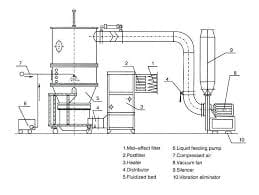
Fluidized bed granulators are widely used in various industries, including pharmaceuticals, for processing materials in a range of applications. These machines are designed to perform granulation, drying, and coating processes with high efficiency. A fluidized bed granulator uses hot air and a dynamic mixing technique to achieve uniform granulation. This section delves into the working principle of these machines, as well as the steps involved in their operation.
Fluidized bed granulators
Step 1: Preparation Phase
The first phase in the operation of a fluidized bed granulator is preparation. Initially, all the raw materials, such as active pharmaceutical ingredients and excipients, must be properly prepared and placed into the product tank. This is where the granulation process will begin.
Simultaneously, it is crucial to ensure that the granulator itself is set up and ready for operation. This includes checking that all components, such as filters and spray systems, are clean and functioning as expected. Additionally, the operator must configure the granulation parameters, which are based on the specifications of the desired granule properties. These parameters typically include airflow rate, temperature, binder spray rate, and particle size.
Once the setup and adjustments are completed, the machine is powered on, and the granulation process can commence.
Step 2: Mixing the Ingredients
In the second phase, the prepared ingredients flow from the product tank into the expansion chamber of the fluidized bed. At this point, hot air is introduced into the chamber, directed through the material at a specific velocity. The air creates an upward force that suspends the solid particles, causing them to float in the chamber. This suspension creates a fluidized bed, where the particles are continuously agitated and mixed in a uniform manner.
The mixing process is crucial for achieving consistency and ensuring that the active ingredients are evenly distributed throughout the granules. The operator must monitor the system to ensure that the particle suspension is optimal for the next step in the granulation process.
Step 3: Granulation Process
During the granulation phase, the hot air continues to pass through the suspended particles, maintaining their floating state. The upward force of the air is counterbalanced by the gravitational pull of the particles, creating an equilibrium that keeps the particles suspended in the air.
At this stage, the particles begin to enlarge as the moisture from the binder solution causes them to bond together. The granules grow in size as the binder is sprayed into the chamber, facilitating the agglomeration process. The addition of the binder helps form granules with the desired properties, such as appropriate size, strength, and flow characteristics.
The operator closely monitors the granulation process to ensure the particles are agglomerating as expected, with proper consistency and homogeneity.
Step 4: Drying the Granules
After the granules have formed and reached the desired size, the next phase involves drying. The binder spraying is halted, and the hot air is maintained in the system to continue drying the granules. This step helps remove excess moisture from the granules, ensuring that they are appropriately dried before collection.
The drying process is critical because any residual moisture left in the granules can affect their stability, quality, and processing during later stages. The operator must ensure that the drying time and temperature are controlled to avoid overheating or under-drying the granules.
Limitations of Fluid Bed Granulators
While fluidized bed granulators are highly efficient, they come with certain limitations that should be considered when choosing them for specific applications. Some of the key drawbacks include:
- Difficulty in Achieving Densification: Fluidized bed granulators may struggle to achieve the desired degree of densification in batch operations, making them less suitable for processes that require high-density granules.
- Extended Residence Time: Fluidized bed granulators generally require longer processing times compared to other granulation methods, which can lead to increased operational costs and reduced throughput.
- Excess Binder Usage: The continuous need to spray binder onto the particles results in the use of large amounts of granulating liquids, leading to higher material costs.
- High Initial Investment: Fluidized bed granulators are expensive to purchase and install, which can be a significant barrier for smaller pharmaceutical companies or those with limited budgets.
- Potential for Filter Clogging and Electrostatic Charge Formation: The filters in fluidized bed granulators are susceptible to clogging, and the equipment can generate electrostatic charges, increasing the risk of solvent explosion during fluidization.
- Production of Low-Density Granules: The granules produced by fluidized bed granulators typically have low density, which may not meet the requirements for certain products.
Is Fluid Bed Granulation the Best Option for Wet Granulation?
Fluidized bed granulation is considered one of the best options for wet granulation due to its ability to improve the properties of granules, such as flowability and compressibility. This makes it an ideal choice for pharmaceutical applications, where precise control over the properties of the final product is essential. Fluidized bed granulation also helps maintain the stability of the product, reducing the risk of segregation.
Alternative Equipment for Wet Granulation
While fluidized bed granulators are often used for wet granulation, other equipment can also perform the same function. High shear granulators and fluid bed processors with spray nozzles are commonly used in wet granulation processes. These machines work similarly to fluidized bed granulators but may differ in the specific methods they use to introduce moisture into the granules.
Importance of Wet Granulation
Wet granulation is an essential process in the pharmaceutical industry due to the following reasons:
- Improved Flowability: The introduction of moisture during granulation helps increase the size of the granules, improving their flowability and making them easier to handle during further processing.
- Enhanced Compression and Densification: Wet granulation improves the ability of the granules to be compressed into tablets and other solid dosage forms. This is particularly important for ensuring the uniformity and consistency of the final product.
- Safety: Wet granulation is safer than dry granulation because it minimizes the generation of dust, reducing the risk of contamination and ensuring a safer working environment.
- Better Dispersibility: The process enhances the dispersibility of the granules, ensuring that the final product dissolves efficiently when administered.
- Reduced Static Charge Generation: Wet granulation helps minimize the buildup of static charges during the granulation process, improving the efficiency of material handling and preventing issues related to static accumulation.
- Prevention of Cross-Contamination: Wet granulation reduces the likelihood of cross-contamination between different batches, ensuring that the granules remain homogeneous.
- Ease of Achieving Homogeneous Mixtures: The wet granulation process allows for better distribution of active ingredients, ensuring uniformity in the final product.
Spray Nozzle Designs in Fluidized Bed Granulators
Fluidized bed granulators are equipped with various types of spray nozzles that help achieve optimal granulation. Common spray nozzle designs include:
- Pressure Nozzles: These nozzles operate by atomizing the binder solution under pressure, creating a fine mist that can be applied to the particles.
- Rotating Nozzles: Also known as rotary atomizers, these nozzles use rotation to disperse the binder solution, often used for drying applications.
- Airless Spray Nozzles: These nozzles work by splitting the fluid into two streams, which then converge at the nozzle orifice, forming a fine mist.
- Gas Atomizing Nozzles: These nozzles atomize the binder solution using compressed air, making them one of the most commonly used nozzle types in fluidized bed granulators.
Factors Influencing the Choice of Spray Nozzle
When selecting a spray nozzle for a fluidized bed granulator, the following factors must be considered:
- Processing Requirements: The nature of the granulation process—whether it is batch or continuous—can influence the choice of nozzle.
- Operational Mode: The nozzle type should align with the intended operational mode of the equipment, ensuring efficient and consistent spraying.
- Application Needs: The specific application and desired granule characteristics (such as size, density, and uniformity) will determine the optimal spray nozzle type.
By understanding these factors, operators can choose the most appropriate spray nozzle for their granulation needs, ensuring optimal performance and product quality.
This detailed overview provides insight into the functionality and limitations of fluidized bed granulators, explaining their operation and the factors to consider when using them for pharmaceutical wet granulation processes.