
|
Getting your Trinity Audio player ready... |
Comparison Between High Shear Granulators and Fluid Bed Granulators
High shear granulators and fluid bed granulators differ in several aspects based on their operating principles.
High Shear Granulators:
- These machines consist of different components with specific roles.
- They require a more complex process, often involving multiple stages.
- High shear granulators are more accurate in producing granules of consistent size compared to fluid bed granulators.
- They don’t rely on blowing hot air through particles, unlike fluid bed granulators.
Fluid Bed Granulators:
- All granulation processes take place in one location.
- Fluid bed granulators are easier to operate because they involve fewer steps.
- They work by passing hot air through powder particles to form granules.
- Fluid bed granulators are less precise in producing uniform granule sizes.
Importance of Granulation Before Tableting
Granulation is crucial before tableting due to the following reasons:
- Enhances powder flow properties.
- Improves powder compressibility before compression.
- Minimizes powder component segregation.
- Reduces dusting, which poses environmental and health risks.
Impact of Wet Granulator Design on Efficiency
The design of wet granulators directly influences the efficiency of the granulation process. It affects both raw material feeding and product discharge methods.
- High Shear Granulators: These produce a wet mass during granulation, which is discharged through a wet mill to break up agglomerates.
- Fluid Bed Granulators: Offer versatile raw material feeding and product discharge methods, including pneumatic conveying, vacuum transport, and gravity feed.
- Design features like close coupling can improve system integration, reducing onsite work during installation.
What is Fluid Bed Granulation?
Fluid bed granulation involves adding a binder liquid to primary particles to form granules. This process uses high-velocity air to suspend powder particles, forming a fluidized bed where agglomeration occurs.
Difference Between Powder, Granules, and Pellets
- Powder: Fine, dry particles resulting from grinding or crushing, with the smallest size.
- Granules: Compact particles formed by combining powders, larger than powders but smaller than pellets.
- Pellets: Small, round particles formed by compressing substances, larger than both powders and granules.
Main Parts of Wet Granulators
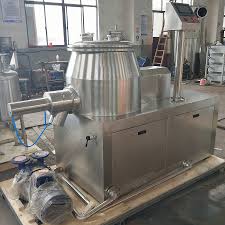
The components of a wet granulator, especially high shear machines, include:
- Granulation Drum: A stainless steel container that houses blending accessories like choppers and mixing blades.
- Impeller: Spreads the granulation fluid and mixes materials at different speeds.
- Granulator Chopper: A secondary high-speed impeller that breaks down lumps to create granules.
- Sealing Mechanism: Teflon seals prevent leaks during the process.
- Motor Drive Mechanism: Controls the impeller and chopper’s speed, typically with variable frequency drive systems.
- Granule Discharge System: Guides finished granules to the discharge port for further processing.
- Spraying Nozzle: Delivers the binder solution to the material evenly.
- Electrical Control Panel: Controls parameters like speed and temperature, often via a touchscreen PLC or HMI system.
How Wet Granulators Work
Wet granulators, especially high shear granulators, follow these steps:
- Filling: The granulation bowl is automatically filled with materials.
- Mixing: Impellers and choppers work at different speeds for optimal mixing.
- Granulation Solution Addition: A binder solution is sprayed onto the particles, causing agglomeration.
- Discharge: The granules are discharged and sent to a milling chamber for size reduction.
Fluid Bed Granulation Process
Fluid bed granulation uses air to fluidize the particles, making them behave like a fluid. The process steps are:
- Fluidizing the Bed: Air is blown through the particles, causing them to fluidize.
- Adding Granulation Fluid: The binder solution is sprayed onto the particles, causing them to stick together and form granules.
- Drying: Hot air continues to flow through the bed to dry the granules once they’ve reached the desired size.
What is a High Shear Mixer?
High shear mixers disperse one phase of ingredients into another, typically immiscible phase, and are used to create emulsions, suspensions, or granular products. They are widely used for reducing particle sizes and homogenizing materials.
Granule Density and Uniformity in Wet Granulators
Wet granulators produce denser and more uniform granules through agglomeration, where small particles form larger, stable aggregates. The process can use either dry or wet agglomeration, with wet agglomeration involving the addition of a binder to form liquid bridges between particles. These bridges hold the particles together after drying, leading to consistent and dense granules.
Choosing Wet Granulators: Key Considerations
When selecting a wet granulator, important factors include:
- Machine Dimensions: Size and weight of the machine, including diameter and length.
- Operating Speed: The speed of rotation, influencing granule production rate.
- Capacity: The amount of raw materials the machine can process within a set time.
- Automation Level: Automatic systems with PLC controls offer ease of operation and consistency.
- Quality: Ensure compliance with ISO, CE, and GMP standards for reliable performance.
Factors Affecting Product Characteristics in Wet Granulation
Several factors influence the granules produced:
- Powder Properties: Wettability, density, and size of the particles.
- Binders: The type and amount of binder added to the powder.
- Granulating Machine: The choice of equipment, such as fluidized bed granulators or planetary mixers.
- Drying and Milling: Equipment used for drying and milling, like fluid bed dryers or wet mills.
Drying Granules from Wet Granulators
Common drying methods include:
- Tray Drying Ovens: Simple but labor-intensive and may result in uneven granule properties.
- Fluid Bed Dryers: Faster and more efficient, offering uniform drying.
Industries Using Wet Granulators
Wet granulators are essential in various industries, including:
- Pharmaceutical manufacturing
- Chemical processing
- Food and beverage production
- Fertilizer manufacturing
Oscillator Granulator in Wet Granulation
Oscillator granulators can be used in small-scale wet granulation processes, making them suitable for lab-scale or low-volume applications.
Common Problems in Wet Granulation
Challenges that can arise include:
- Under Granulation: Insufficient binder causes poor agglomeration, leading to suboptimal particle properties.
- Over Granulation: Excessive binder leads to large particles that disrupt material blending.
- Large Particle Size Distribution: Caused by improper binder addition, incorrect pressure application, or incorrect drying conditions.
Regular monitoring and machine maintenance can prevent these issues.