
|
Getting your Trinity Audio player ready... |
Understanding the Differences Between Industry 1.0, 2.0, 3.0, and 4.0
Industry :Over the course of history, the industrial sector has undergone several transformative phases, each marked by significant technological advancements. These stages, known as industrial revolutions, have reshaped the global economy, changed how goods are produced, and altered everyday life. Each revolution built upon the achievements of its predecessor, bringing about new innovations that changed the course of industries and societies alike. Let’s explore the key distinctions among Industry 1.0, 2.0, 3.0, and 4.0.
Industry 1.0: The Age of Mechanical Production
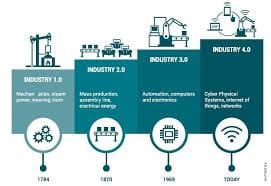
The first industrial revolution, which began around the 1760s in Britain, marked a monumental shift from manual labor and agrarian-based economies to mechanized production. This era was characterized by the introduction of water power and steam engines, which revolutionized the manufacturing process.
Before this period, most goods were produced by hand or with rudimentary tools. The innovation of mechanized spinning and weaving machines in the textile industry was one of the major breakthroughs. Steam power, in particular, allowed machines to function more efficiently and operate independently of human or animal labor. This led to the development of large-scale industries such as textiles, iron smelting, and coal mining.
The impact of Industry 1.0 was profound. Products became more affordable and accessible, and urbanization began to accelerate as people moved to cities to work in factories. While it brought about economic growth, it also introduced new social challenges, including labor exploitation and poor working conditions.
2.0: The Rise of Mass Production and Electricity
The second industrial revolution emerged in the late 19th century, around the 1870s. It was distinguished by the widespread adoption of electricity as a source of power, which led to significant improvements in manufacturing capabilities.
With the introduction of electric power, factories no longer had to rely on steam engines or water mills. This allowed production facilities to be more flexible in terms of location and layout. More importantly, electricity enabled the development of the assembly line—a game-changing concept that allowed for the mass production of goods.
Industries such as automotive manufacturing flourished during this time. One of the most well-known figures of this era, Henry Ford, revolutionized automobile production with the moving assembly line, drastically reducing production time and cost.
This period also saw the development of new materials like steel and chemicals, as well as improvements in transportation and communication networks. The quality of life improved for many, and job opportunities expanded as new roles in manufacturing and engineering emerged. Overall, Industry 2.0 greatly enhanced productivity and efficiency while laying the groundwork for modern industrial economies.
3.0: The Digital Revolution
The third industrial revolution, often referred to as the Digital Revolution, began in the late 20th century—specifically during the 1970s. This era introduced digital technologies, particularly computers and information technology, into the industrial space.
The central feature of Industry 3.0 was the automation of manufacturing processes through electronics and software. Programmable logic controllers (PLCs), microprocessors, and computers became common on factory floors. These tools enabled machines to perform tasks with minimal human intervention, increasing precision, speed, and consistency.
Automation brought about a dramatic shift in how industries operated. Processes that once required large teams of workers could now be managed by a handful of operators overseeing computer-controlled systems. This not only reduced labor costs but also significantly improved quality control and safety.
Furthermore, Industry 3.0 marked the beginning of globalization in manufacturing. With digital tools, businesses could coordinate production across multiple locations around the world. The integration of IT into industry also gave rise to new sectors such as electronics, telecommunications, and software development.
4.0: The Era of Smart Manufacturing
The concept of Industry 4.0 was first introduced in Germany in 2011 as part of a high-tech strategy to digitize manufacturing. Often called the Fourth Industrial Revolution, Industry 4.0 represents a shift toward intelligent, interconnected systems that communicate and make decisions with minimal human input.
At the core of Industry 4.0 are advanced technologies like the Internet of Things (IoT), artificial intelligence (AI), big data analytics, and cyber-physical systems. These technologies work together to create “smart factories” where machines and systems are capable of collecting data, analyzing it in real time, and making autonomous decisions based on that information.
For example, IoT-enabled machines can monitor their own performance and predict maintenance needs before a breakdown occurs. AI can optimize production schedules based on real-time supply and demand data. Cloud computing allows for seamless data sharing across entire supply chains.
One of the major benefits of Industry 4.0 is the ability to offer greater customization without sacrificing efficiency. Products can be tailored to specific customer needs while still being produced at scale. Additionally, enhanced connectivity and automation improve supply chain visibility, reduce waste, and increase responsiveness to market changes.
However, this digital transformation also presents challenges, particularly regarding cybersecurity, data privacy, and the need for a workforce skilled in digital technologies.
Looking Ahead: Industry 5.0
As Industry 4.0 continues to evolve, we are beginning to enter a new phase known as Industry 5.0. While Industry 4.0 focuses on machine-to-machine communication and autonomous systems, Industry 5.0 emphasizes collaboration between humans and advanced technologies.
The goal of 5.0 is to strike a balance between automation and human input. It envisions a future where smart machines and robots handle repetitive, data-driven tasks while humans contribute creativity, empathy, and critical thinking. This partnership aims to increase productivity while maintaining a human-centered approach to manufacturing.
Technologies like artificial intelligence, advanced robotics, and cognitive computing will be key drivers of Industry 5.0. These systems will be able to learn from human feedback, adapt in real time, and enhance human capabilities rather than replace them.
Another core principle of Industry 5.0 is sustainability. There is a growing emphasis on using technology to minimize environmental impact, improve resource efficiency, and create more resilient and ethical production systems.
Conclusion
The journey from Industry 1.0 to 4.0 (and now toward 5.0) reflects humanity’s ongoing pursuit of innovation and efficiency. Each revolution has built upon technological advancements that reshaped how we work, produce, and live.
- 1.0 introduced mechanical power through water and steam.
- 2.0 brought about electricity and mass production.
- 3.0 introduced computers and automation.
- 4.0 created intelligent, connected manufacturing environments.
With 5.0 on the horizon, the focus shifts toward harmonizing technological progress with human values—ensuring that innovation serves both economic goals and the well-being of society.